

MLS-inspired custom soccer kit design ideas for 2026 pair professional-level visual storytelling with practical choices amateur clubs can manage. Start with a club’s history, place, or identity, then translate that story into color, pattern, and typography. A clear design brief and an approved digital proof help turn inspiration into a cohesive kit rather than a copy of a professional team’s shirt, and this guide to custom soccer kits for local leagues offers practical advice for teams planning their own.
1. What Makes an MLS-Inspired Kit Design?
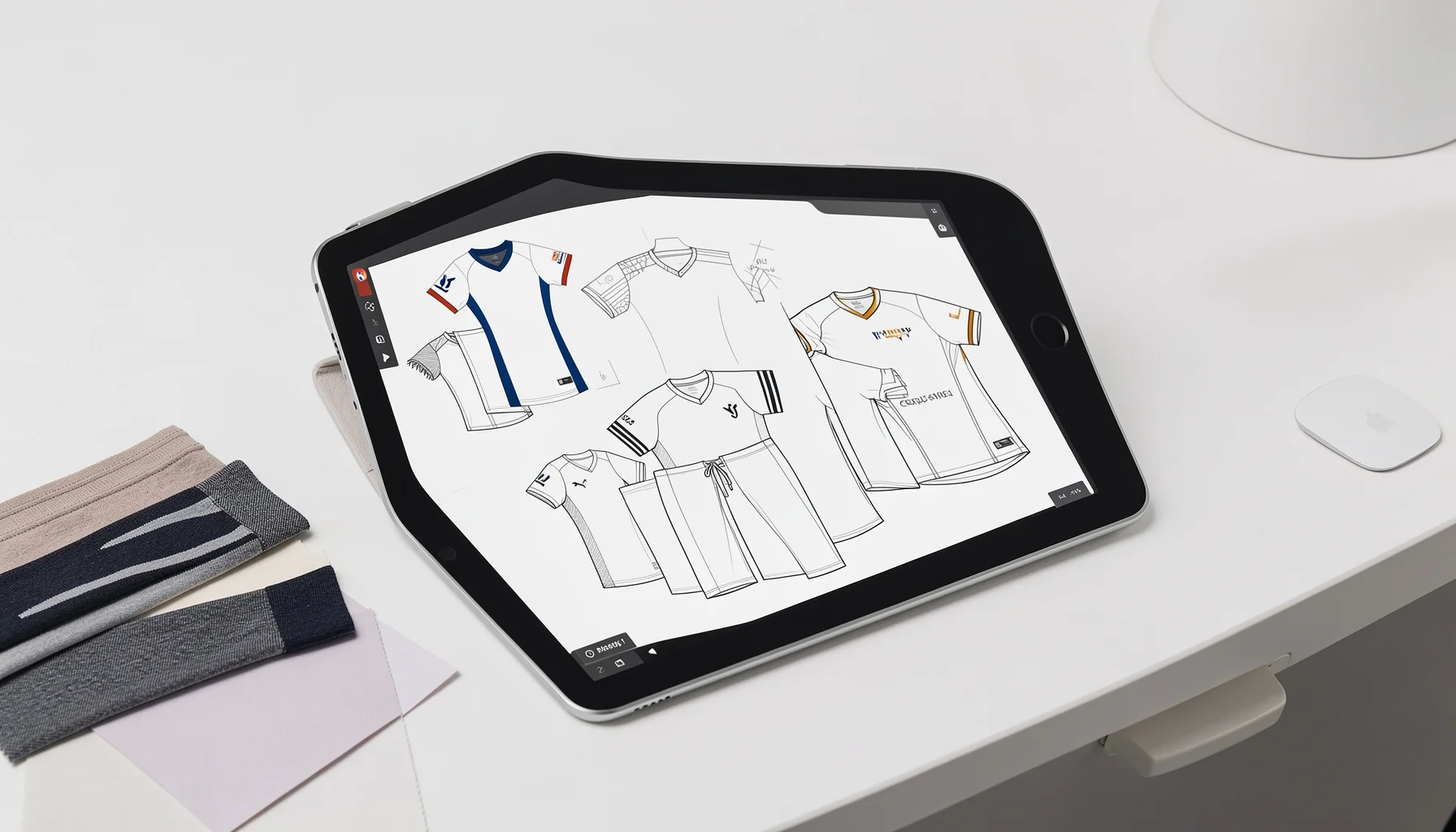 MLS-Inspired Custom Soccer Kit Design Ideas 2026 - 2. Design Specifications and Production Workflow
An MLS-inspired kit borrows design principles from professional soccer—such as local storytelling, distinctive patterning, and deliberate typography—without reproducing a club’s official uniform. For amateur teams, the strongest approach is to use those principles to express their own identity and make design choices that work across the full roster.
From professional releases to amateur design principles
The 2026 MLS kit landscape offers useful examples of how a uniform can communicate more than team colors. Reporting on the season highlights heritage-led concepts, retro references, bespoke typography, and abstract or geometric motifs. All 30 MLS clubs launched new bespoke kits for the 2026 season, and the releases were officially launched by February 11, 2026. These are industry context, not a requirement that amateur teams follow one specific look.
A club can adapt the underlying method:
- Tell a local story: Start with a neighborhood landmark, club milestone, regional landscape, or community tradition.
- Build a recognizable visual system: Connect the shirt’s colors, pattern, badge placement, and lettering instead of treating each element separately.
- Choose a practical design vocabulary: Use a few strong, legible elements rather than layering every reference onto the jersey.
The aim is not to imitate a professional team’s finished shirt. It is to understand how a design communicates identity and apply that thinking to a different club.
How to translate heritage and trends into a team identity
Heritage storytelling works best when the reference is specific. A club might use a simplified local map line, a landmark silhouette, or a date tied to its founding. Retro inspiration can come from the team’s own past: an older badge, a former color combination, or a familiar stripe pattern. These references should support the current identity, not compete with it.
Typography is another important part of the visual system. A distinctive number or name treatment can make a kit feel personal, but it still needs to be easy to read at a distance. Similarly, geometric and abstract motifs—from map-like lines to ripples or structured stripes—can add depth without requiring a complex palette.
Legendkits’ design approach emphasizes selecting a style, team colors, and finish, then personalizing names and numbers. That makes it useful to plan the design as a system: establish the main visual idea first, then test how the badge, lettering, and player details fit around it.
Make inspiration original and usable
Professional references are most valuable when they prompt a question: what story should this club’s kit tell? A youth team may prioritize a clear, energetic look; a long-running amateur club may want to foreground its history; a family or fan group may prefer a design that feels connected to a shared team identity.
Before choosing details, write a short brief that answers:
- What should the kit communicate?
- Which colors are essential to the club?
- What local or historical reference is meaningful to members?
- Which details must remain visible on the jersey?
- Who needs to approve the final design?
This brief helps prevent a common mistake: collecting appealing ideas without deciding which one is central. A focused concept gives designers a way to judge whether each pattern, color, or type choice belongs.
2. Design Specifications and Production Workflow
A successful custom kit connects visual decisions to production and approval steps. The table below summarizes the choices a club can make and the confirmed Legendkits workflow, without treating a design trend as a production guarantee.
Compare design choices by purpose
| Design element or workflow stage | Practical options or facts | What the team should check |
|---|---|---|
| Visual direction | Heritage story, retro reference, bespoke typography, geometric or abstract pattern | Does the idea express the club’s identity rather than copy another team? |
| Style and colors | Select jersey style and team colors using the design tools | Do the colors and pattern work together and remain recognizable? |
| Finish | Premium stitched tackle twill or high-quality printing | Which finish best suits the planned design elements? |
| Personalization | Custom names and numbers | Are all spellings, number assignments, and placements correct? |
| Design approval | Free digital design proof before production | Has an authorized team representative checked the proof? |
| Production | 1–3 business days after approval | Is the approval complete before the order enters production? |
| Total turnaround | 6–11 business days | Does the timing fit the team’s event or season schedule? |
| Order size and shipping | No minimum order quantity; free standard shipping on U.S. orders | Does the order plan reflect the actual roster and delivery destination? |
Choose finishes based on the design
Legendkits offers a choice between premium stitched tackle twill and high-quality printing. These are finishing options, not interchangeable claims about which design is universally better. A club should consider how the intended artwork will be represented and review the proposed design proof before production begins.
For example, a concept built around clear lettering and a bold number may call for a different treatment from one centered on a more detailed visual motif. The available facts do not establish that every pattern or artwork can be reproduced in every finish, so the proof is the practical point at which to confirm how the proposed design will appear.
The same discipline applies to typography. A bespoke-style font can reinforce a club’s personality, but the name and number must remain readable. If a type treatment is decorative, check it at the size and position shown on the proof rather than judging it only in a large concept image.
Treat the proof as a decision checkpoint
Every Legendkits order includes a free digital design proof for approval before production. This step is part of quality assurance: it gives the team an opportunity to review the design and personalization before the order moves forward.
The proof should be checked by someone authorized to confirm the team’s choices. Review the overall color balance, the placement of the main visual idea, and the accuracy of every custom name and number. Keep feedback specific—such as correcting a spelling or adjusting a color choice—so the design team can interpret it clearly.
Production begins after approval and takes 1–3 business days. The stated total turnaround is 6–11 business days. Because approval is a prerequisite to production, the team should account for its own review time when planning around a match, tournament, or season start.
3. A Step-by-Step Kit Design and Ordering Guide
A practical kit workflow moves from identity to visual choices, personalization, proof review, and production. Clubs that make decisions in that order can reduce avoidable revisions and check the final design against the people who will wear it.
 MLS-Inspired Custom Soccer Kit Design Ideas 2026 - 1. What Makes an MLS-Inspired Kit Design?
Step 1: Write a concise design brief
Before opening design tools, agree on the purpose and identity of the kit. Record the core colors, one main story or reference, and the overall impression the team wants to create. A useful brief might say: “Use our club colors, reference our neighborhood’s riverside setting through a subtle ripple motif, and keep player numbers highly legible.”
Keep the brief short enough to guide choices. A long list of unrelated influences makes it difficult to know which direction should lead. If the team is considering a retro look, specify whether the inspiration comes from its own history or from a broader era. That distinction helps the final design feel personal rather than borrowed.
Step 2: Select a style, colors, and finish
Use the Legendkits design tools to select the jersey style, team colors, and finish. Compare options against the brief: does the pattern support the story, and do the colors preserve a recognizable team identity? Resist adding a motif simply because it is a 2026 trend. A trend should help express the concept, not replace it.
Consider whether stitched tackle twill or high-quality printing is appropriate for the proposed treatment. The available information confirms both options but does not specify material, care, or performance differences between them. For that reason, base the choice on the design presented and what is confirmed through the order process, not on assumptions about technical properties.
Step 3: Enter personalization carefully
Add custom names and numbers only after the main design direction is stable. Gather each player’s preferred name and assigned number in a single roster document, then use that document as the source for order entry. This reduces the risk of mismatched spellings or duplicate assignments.
Ask one person to coordinate the roster and another to verify it. The second review is especially valuable for names with unusual spelling, changing lineups, or late additions. Legendkits does not require a minimum order quantity, so teams can order small batches or individual custom jerseys. That flexibility can be relevant for a club with a small roster or a group arranging individual apparel.
Step 4: Review and approve the digital proof
When the free digital proof arrives, review it against the brief and roster. Check the overall visual balance, the team colors, the chosen finish as represented in the proof, and every name and number. Confirm that the design still feels connected to the club’s identity when viewed as a complete kit.
Collect feedback in one round where possible. Ask reviewers to identify specific changes and assign one person to submit the consolidated response. Once the authorized representative approves the proof, the order enters production; production takes 1–3 business days.
Step 5: Plan around the full turnaround
The stated total turnaround is 6–11 business days. Work backward from the date the team needs the kit, allowing time to prepare the roster and review the proof before production begins. The production window is not the entire process: the club’s own decision-making and approval time also matter.
Legendkits provides free standard shipping on U.S. orders. Teams should still confirm that the order details and delivery destination are correct and plan around the stated total turnaround rather than assuming production time alone determines arrival.
4. Pro Tips, Common Pitfalls, and the 2026 Outlook
The most reliable results come from a clear concept, readable personalization, and a disciplined proof review. For clubs ordering as a group, centralized decisions are especially important: visual direction, roster accuracy, and approval should each have an identifiable owner.
Solve common design problems before approval
A design can feel unfinished when its elements do not share a purpose. It can also feel crowded when too many trends compete for attention. Use these checks before submitting final approval:
- If the pattern overwhelms the badge or numbers: simplify the pattern or give the key elements more visual space.
- If a heritage reference is hard to recognize: make it more specific, or reduce it to one clear motif.
- If the lettering looks distinctive but difficult to read: prioritize legibility in the name and number treatment.
- If club members disagree on direction: return to the brief and decide which identity goal matters most.
- If personalization is at risk of error: verify names and numbers against a single final roster.
A corporate or community group can benefit from the same discipline. Teams looking at use cases beyond a soccer club can also review Legendkits’ guide to custom team jerseys for corporate events and retreats, which addresses coordinated apparel for organized groups.
Use case examples: adapt the method, not the shirt
Imagine a youth club whose identity is linked to its town’s river. Instead of copying a professional ripple-patterned jersey, it could use the river as a subtle design cue, retain its established team colors, and keep names and numbers easy to distinguish. The inspiration is the design principle—place-based storytelling—not another club’s exact execution.
A long-standing amateur side might take a different route. It could revisit an older club badge or past stripe arrangement, then use a contemporary layout so the result feels connected to history without appearing like a replica. A fan group or family ordering a small number of jerseys might focus on a shared color scheme and individual names, taking advantage of the no-minimum-order policy.
These examples are design scenarios, not descriptions of specific Legendkits customers or guaranteed production outcomes. In each case, the brief identifies the story, the tools support style and color selection, and the proof gives the group a chance to confirm the proposed result before production.
Plan for clubs, leagues, and larger groups
For a club or league, the design process becomes a coordination task as well as a creative one. Identify who owns the artwork decisions, who maintains the roster, and who can approve the proof. If several teams share a visual identity, agree which elements are consistent across the group and which can vary between squads.
The no-minimum policy can accommodate small-batch and individual orders, while the stated 1–3 business day production window and 6–11 business day total turnaround provide planning benchmarks. These figures should be used as stated, not expanded into guarantees about a particular event date. Allow time for the club’s internal approvals and proof review.
Looking ahead, 2026 design coverage points to a broad mix of heritage narratives, retro references, custom typography, and abstract patterns. For amateur teams, the strategic takeaway is not to adopt every direction. It is to select a design language that will remain meaningful to the club after the season’s trend cycle passes.
FAQ
What are MLS-inspired custom soccer kit design ideas for 2026?
They are original amateur-team concepts informed by design directions visible in professional soccer, including heritage storytelling, retro references, bespoke typography, and geometric or abstract patterns. The phrase describes inspiration, not an official MLS product or a requirement to copy a professional club. A strong amateur design uses those ideas to communicate its own history, location, or identity while keeping colors, names, numbers, and other visual elements coherent.
How can an amateur club use MLS trends without copying a professional team?
Start with a story that belongs to the club, such as a local landmark, community tradition, or its own history. Then choose colors, a pattern, and typography that support that story. Avoid reproducing another club’s distinctive finished design. For example, a team can use a map-inspired motif as a general design approach while creating a pattern based on its own surroundings. Review the complete concept for originality and readability before approving the proof.
What is the custom jersey workflow at Legendkits?
Choose a jersey style, team colors, and finish using Legendkits’ design tools, then enter custom names and numbers. Legendkits provides a free digital design proof for approval before production begins. After approval, production takes 1–3 business days, with a stated total turnaround of 6–11 business days. Every order can be placed without a minimum quantity, and free standard shipping is available on U.S. orders.
What should a team check on its digital design proof?
Compare the proof with the approved design brief and roster. Check the overall color choices, pattern balance, placement of important design elements, and accuracy of each custom name and number. Review the selected finish as represented in the proof, and make sure the lettering remains easy to read. Have an authorized representative consolidate feedback and confirm approval. Because production starts after approval, resolve corrections before giving the final sign-off.